

Personal Wellbeing: A Results-Driven,
Root-Cause Approach
With Results Driven Therapy, Texas No Longer Needs an Annual Counseling Subscription
Therapy should not be a permanent subscription. At Weeping Pines, we provide Results Driven Therapy in Texas (based in Amarillo), because we believe your time is valuable. Too often, the industry model is built on creating dependency—keeping clients on the roster week after week, year after year, just to bill a session. My philosophy is fundamentally different. I am driven by one thing: results. When you enter my office, the goal is not to keep you here forever; it is to get you healed, equipped, and back into your life.
If a certain angle isn’t moving the needle, we don’t sit in the stagnation—we change lanes, adjust the strategy, and find a new way forward. Because of this results-oriented approach, my client roster revolves dynamically. I am a highly specialized therapist for this area, but that doesn’t mean you will be stuck on a waiting list for three years to see me. I get clients in, we do the heavy lifting, and they graduate from therapy, opening the door for the next person who needs help.
Beyond the Specialties: A Universal Framework for Healing with Results Driven Therapy: Texas-Wide
While my practice is known for specialized work in complex trauma, substance use, and identity transitions, you absolutely do not need to fit into one of those specific boxes to “sit on my couch.” You don’t have to be navigating a severe addiction or a major life crisis to benefit from a fundamentally different approach to therapy I have developed during my tenure of Mental Health Counseling.
The truth is, the same underlying mechanics that drive trauma responses—a profound loss of control, deep discouragement, and the nervous system’s frantic attempts to adapt—are often at the exact root of everyday anxiety, persistent depression, and feeling generally “stuck.” It’s just when left unattended for too long, it can manifest into severe trauma, substance use, or identity crises. Because human behavior is universally purposeful, the highly effective Adlerian and SFBT frameworks I use are incredibly adaptable. We apply the exact same out-of-the-box, results-driven thinking to a wide spectrum of other ailments.

While I hold deep specializations in career transition, first responder trauma, LGBTQ+ experiences, and substance use, my scope does not end there. The trauma-informed, goal-directed framework I utilize is highly effective for a wide spectrum of personal wellbeing concerns. If you are struggling with mood disorders, anxiety, depression, relational conflict, or simply feeling “stuck” in life, we can work together. You do not have to fit into a specific specialized box to receive high-level, clinically innovative care.
The Root Cause: Trauma, Control, and Adaptation
My approach to therapy is unique because I do not pathologize your coping mechanisms. All of my modalities are deeply connected, rooted in how humans respond to trauma, abandonment, and a loss of control or a lack of tolerance to that loss of control. The amount of “stress” were able to tolerate directly correlates to the level of mental anguish, or distress, we experience:
Rejecting Shame-Based Models:
I am not a fan of traditional models that heap shame onto clients. For example, rigid abstinence-only 12-step programs often weaponize a client’s minor missteps, adding guilt to an already volatile internal world. Similarly, the barbaric practice of conversion therapy leaves horrific scars of self-loathing. My practice focuses on harm-reduction and forward momentum, validating your history without letting it trap you.
Rethinking “Addiction” and Coping:
Whether we are addressing substance use, eating disorders, or Cluster B personality dynamics, my perspective is that you are rarely addicted to the substance or the vice itself. You are addicted to the emotional response elicited when you attempt to regain a sense of control. When life strips away your autonomy or stability, vices—from shopping, to illicit drugs, to interpersonal manipulation—are attempts to self-soothe and artificially manufacture the positive feeling of being in the driver’s seat.
Deep Identity Exploration over Hasty “Fixes”:
Growing up as a gay man in the Bible Belt of Amarillo, I deeply understand how subtle and abrupt systemic discrimination causes severe emotional trauma and attachment wounds. When dealing with complex issues like Gender Dysphoria, I believe in mediating the intimate internal dialogue before jumping to permanent interventions. True healing requires distinguishing genuine dysphoria from other trauma responses or borderline traits, ensuring we aren’t using a physical transition as a hasty band-aid for deeper psychological discourse.
The Clinical Framework for Results Driven Therapy: Texas-Style
To achieve these results, my practice integrates two powerful psychological modalities, viewed through a trauma-informed lens. We use Adlerian Therapy to understand the foundation of your behaviors, and Solution-Focused Brief Therapy (SFBT) to build the momentum for your future.
The Foundation: An Ode to Alfred Adler
Adlerian therapy is a short-term, holistic, and empowering approach. It treats individuals not as victims of their past, but as creative, proactive authors of their choices. In this model, what traditional therapy labels as “misbehavior” or “pathology” is often just profound discouragement.
Key Components of the Adlerian Approach:
- Social Interest (Gemeinschaftsgefühl): Fostering a sense of community, belonging, and empathy to combat the extreme loneliness of trauma.
- Holistic View: You are responsible for your choices and are capable of restructuring your goals to create positive change.
- Inferiority vs. Superiority: We address how feelings of inferiority (powerlessness/loss of control) fuel unhealthy neurotic behaviors, and redirect that energy to motivate genuine success and growth.
- Goal-Oriented Behavior: Understanding that your behavior is purposeful, aimed at achieving specific goals (often a misguided attempt to regain control or overcome personal limitations).
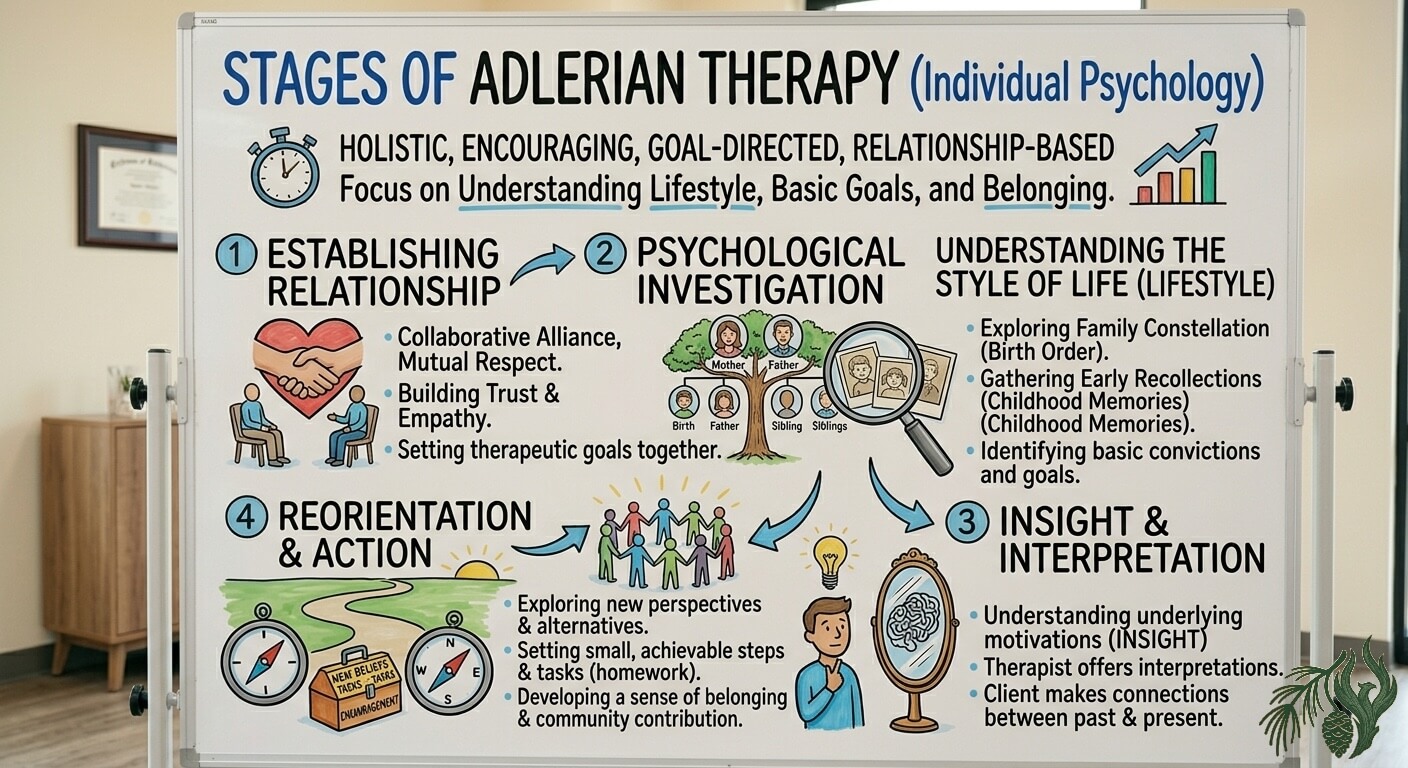
Our Four Phases of Adlerian Therapy:
Reorientation:
Encouraging you to develop functional ways of thinking through action-oriented techniques like “Acting As If,” “Catching Oneself,” and “Spitting in the Soup” (identifying hidden motivations to make self-defeating behaviors less attractive).
Engagement:
Building an empathetic, egalitarian, and trusting relationship.
Assessment:
Exploring your lifestyle, family dynamics, birth order, and “basic mistakes” in thinking.
Insight:
Helping you understand your deeply hidden motivations—why you behave in certain ways and how it serves your goals.
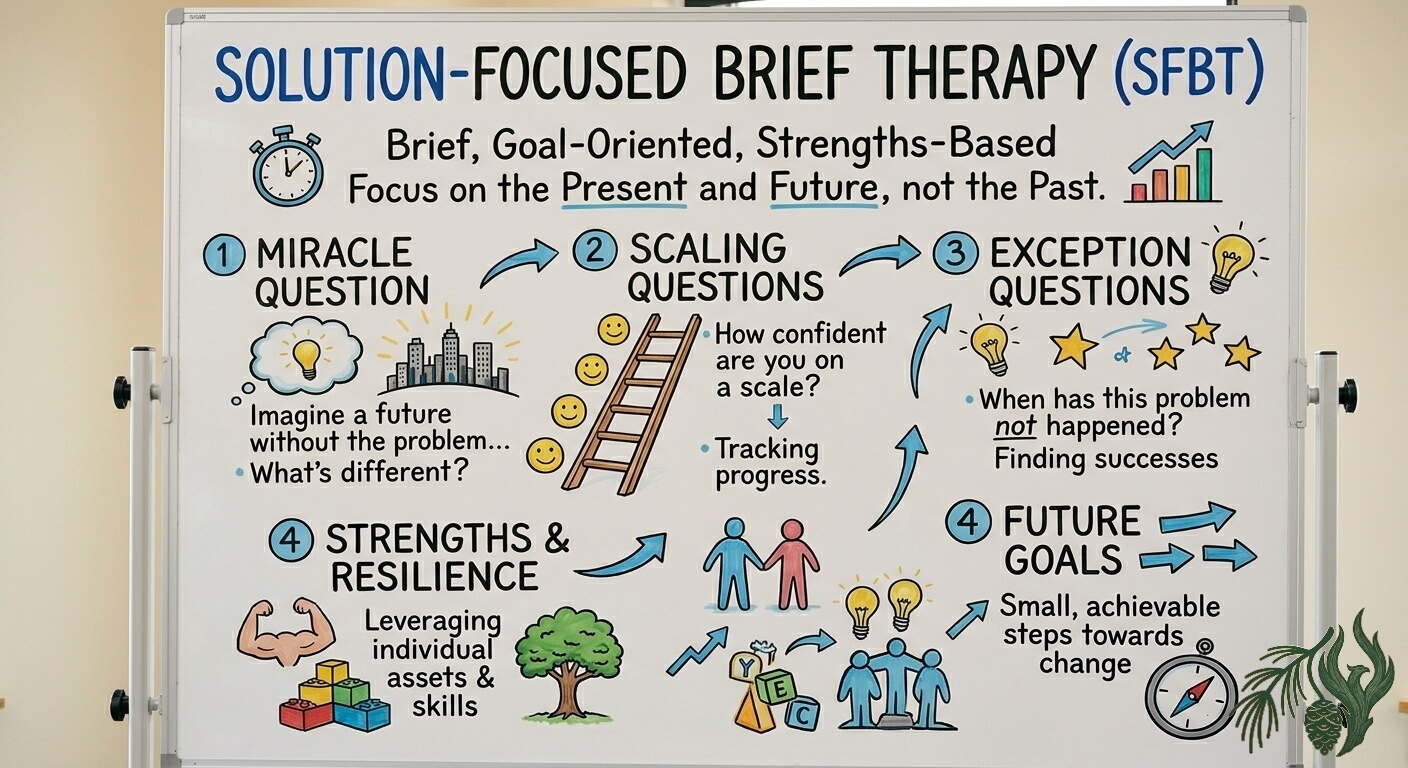
The Forward Momentum: Solution-Focused Brief Therapy (SFBT)
If Adlerian therapy helps us understand why you are discouraged, SFBT provides the exact roadmap for how we get you out of it. Developed in the late 1970s by Steve de Shazer and Insoo Kim Berg, SFBT is a direct pushback against traditional, endlessly problem-focused psychoanalysis. It is incredibly practical and future-focused.
Core Concepts of SFBT:
- The Shift from “Why” to “How”: We spend less time dwelling on why a problem exists and dedicate our energy to discovering exactly how you can achieve your goals.
- Finding “Exceptions”: We identify the times when your problem is not happening. These exceptions are the raw materials for your personalized solutions.
- Actionable Steps: Using collaborative tools like the “Miracle Question” and scaling techniques, we identify small, realistic, and highly actionable steps toward immediate change.
I have used these modalities together to formulate a results driven therapy Texas can use to get results; these modalities ensure you leave therapy not just with a profound understanding of your past, but with a highly effective, shame-free strategy for your future.
Addressing Mood Disorders Beyond the Label
When dealing with mood disorders such as severe anxiety, depression, or emotional dysregulation, the traditional mental health system often hands you a label and a lifetime management plan. While I deeply validate the exhausting, very real physiological weight of these conditions, my approach is fundamentally different. I do not view you as your diagnosis.
Through our trauma-informed, Adlerian framework, we look at mood disorders differently:
- Depression as Deep Discouragement: Rather than viewing depression solely as an inescapable chemical flaw, we explore it as a state of profound discouragement. Often, it is the result of a prolonged loss of control or a crushed sense of belonging. We work to uncover the root of this exhaustion and systematically rebuild your sense of agency.
- Anxiety as the Fight for Control: Anxiety is rarely just “worry for the sake of worry.” It is often the mind and body’s frantic, exhausting attempt to predict the future and regain control in a world that feels unsafe or unpredictable.
- Emotional Dysregulation: Similar to our approach with complex trauma and Cluster B traits, we view intense emotional swings or rigid, black-and-white thinking as protective adaptations that have outlived their usefulness.
The Strategy for Relief
You don’t need endless sessions of venting about how heavy the depression feels or how loud the anxiety is—you already know what that feels like. You need a strategy to disrupt it.
Using Solution-Focused Brief Therapy (SFBT), we start hunting for the “exceptions.” We look for the moments—even the microscopic ones—where the depression lifts slightly or the anxiety quiets down. By identifying what is happening in those specific moments, we reverse-engineer a practical, actionable roadmap to multiply them. We transition you from feeling like a helpless victim of your moods to an active participant in your emotional regulation.