

Career Counseling in Amarillo & Across Texas: Finding Purpose at Every Stage of Life
The Psychology of Work: Beyond the Aptitude Test
Choosing a career is rarely as simple as taking a multiple-choice aptitude test in high school and blindly following the results. Whether you are stepping into the professional world for the very first time or transitioning from a non-traditional background, the pressure to “get it right” can be paralyzing.
Yet, when faced with the overwhelming pressure of career planning, many individuals fall back on the simplest, most culturally accepted metric: “What will make me the most money?” While financial stability is a valid and vital motivator, building a life around a paycheck while ignoring your psychological makeup is a recipe for internal disaster. If your career only satisfies your wallet but violently clashes with your values, the resulting dissonance will inevitably bleed into your personal life. This lack of fulfillment often manifests dangerously outside of working hours—leading individuals to self-soothe through substance use, seek artificial excitement through affairs, or displace their deep-seated frustrations onto their spouses and children.
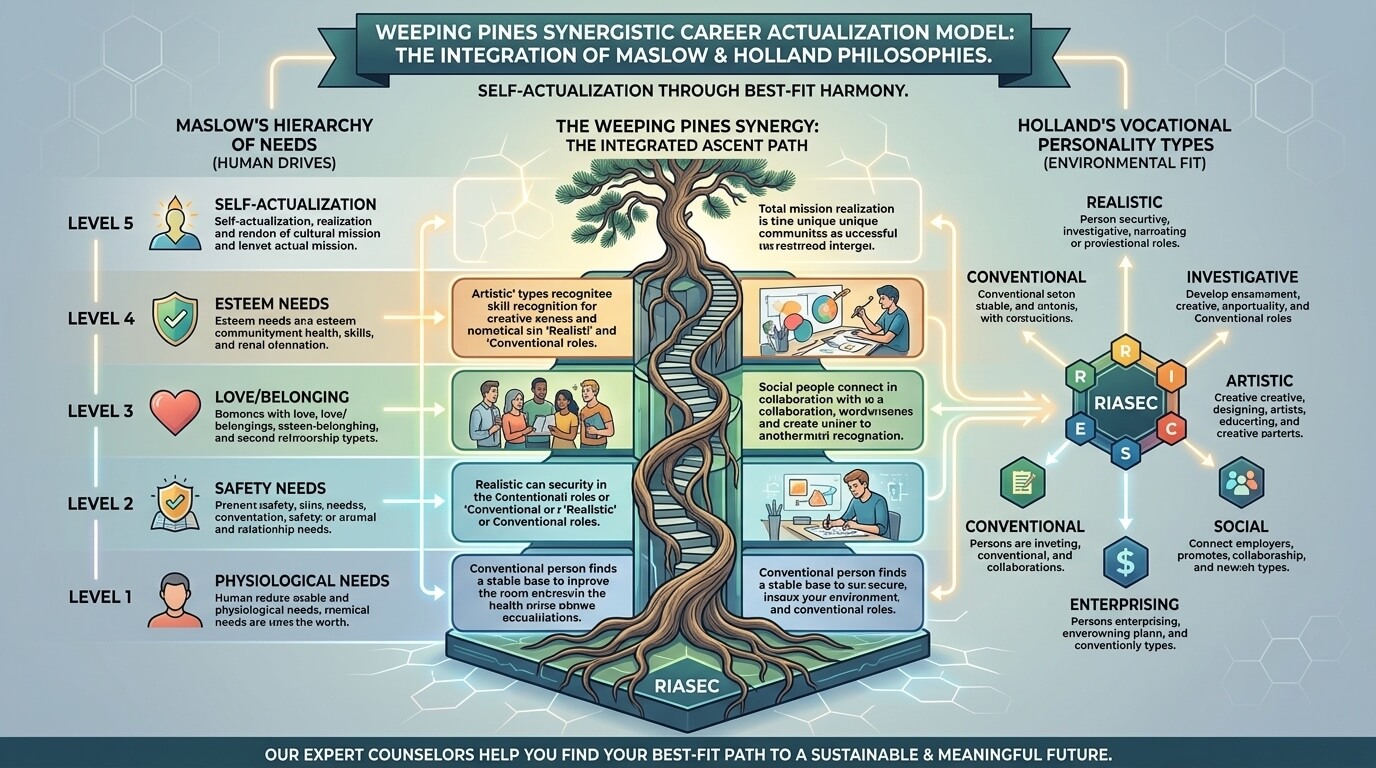
To prevent this, true career counseling must be grounded in psychological framework. We utilize two core psychological theories to ensure your career path is sustainable:
Abraham Maslow’s Hierarchy of Needs:
Maslow theorized that humans have a progressive series of needs. While a high-paying job covers the foundational levels—basic survival and safety—it often stops there. We spend a third of our lives at work; therefore, your career must eventually contribute to the higher tiers of Maslow’s pyramid: a sense of belonging, esteem, accomplishment, and ultimately, self-actualization. If your job isn’t feeding these higher needs, you will feel empty, regardless of your salary.
Our approach goes far beyond updating a resume. We answer the serious psychological questions first, so that when you do enter the workforce, you are driven by lasting purpose.
John Holland’s Vocational Personalities:
Holland’s research demonstrated that people and work environments can be categorized into distinct “personalities.” His core finding is simple but profound: if your inherent personality does not match the environment you work in, the friction will eventually break you down. We work to align your intrinsic traits with the correct vocational environment, ensuring that the daily reality of your job naturally energizes you rather than constantly draining you.

Stage 1: Entering the Arena – Defining Your Start
Whether you are stepping into the professional world for the very first time or transitioning from a non-traditional background, the pressure to “get it right” can be paralyzing. Without the right guidance, it is easy to adopt someone else’s definition of success.
In this stage, we slow down to answer a foundational question: Who are you? We help clients navigate several crucial starting points:
High School & College Students:
The pressure to decide the “rest of your life” at eighteen or twenty-two is immense. Rather than rushing to pick a major based on what sounds impressive, we explore your intrinsic motivations. By aligning your education or trade path with your authentic self early on, we help prevent the devastating mid-career crisis before it ever begins.
Stay-at-Home Mothers Re-entering the Workforce:
The transition from full-time caregiving back into the job market can feel incredibly daunting. You may wonder where to even begin or feel insecure about “gaps” in your resume. We work together to rediscover your individual identity outside of the home, helping you confidently translate the immense, complex management skills of motherhood into highly marketable professional strengths.
Gig Workers & Unused Degrees:
Perhaps you have survived on gig work, bounced between disconnected jobs, or hold a degree you have never actually put to use. If you are finally ready for the stability and structure of a dedicated career path, we will map out the practical steps—whether that means starting a new educational journey from scratch or pivoting to leverage the foundation you already have.
Our goal is not just to help you find a job; it is to help you build a sustainable foundation where your work meets your deeper psychological needs for accomplishment and self-actualization.
Stage 2: The Pivot – Navigating a Career Shift
At some point, the career that once fit you perfectly may start to feel like a cage. As we grow, our values, our psychological needs, and our life circumstances naturally evolve. What fulfilled you at twenty-five may completely drain you at forty.
Many people remain in deeply unfulfilling jobs because of the “sunk cost fallacy”—the belief that because you have invested ten or twenty years into a specific industry, it is too late to start over. You might fear the financial risk, dread the judgment of peers, or simply feel exhausted by the thought of being a “beginner” again.
Whether you are navigating severe corporate burnout, outgrowing a past passion, or realizing your current field no longer supports your family’s needs, we want you to know one thing: profound change is entirely possible at any age and at any career point. Through our career counseling in Amarillo, we help you navigate the fear of the pivot. We will assess how your vocational personality has shifted, identify your highly valuable transferable skills, and create a realistic, step-by-step strategy to transition into a new field. Pivoting is not a sign of failure or wasted time; it is a courageous realignment with who you are right now.


Specialized Career Transition: First Responders & Medical Professionals
While many career shifts are initiated by personal choice, others are forced by external circumstances. Across the state of Texas—and increasingly right here in the Panhandle—the landscape for emergency medical services and specialized healthcare is evolving. Many municipalities and private systems are undergoing significant restructuring, departmental absorptions, and shifts in contract requirements. Often, this includes new mandates for cross-training or obtaining dual certifications (such as mandatory fire certifications) that may not align with every provider’s physical capabilities or original vocational goals.
For first responders, paramedics, and EMTs, a career is rarely just a paycheck; it is a core piece of your identity. When your role is suddenly altered or threatened—not by your lack of dedication or skill, but by systemic administrative changes—the transition is often forced rather than chosen. Being pushed away from a medical calling you love is a profound loss, and experiencing professional whiplash and grief in these moments is completely normal.
As a therapist providing specialized career counseling in Amarillo and throughout Texas, I offer a dedicated space for first responders to process this forced transition. We won’t just look at updating a resume; we will look at your foundational psychological needs. We will work together to process the displacement, and then systematically translate your incredibly unique skill set—crisis management, rapid medical intervention, and high-stress adaptability—into a fulfilling, sustainable new career path. You do not have to lose your internal drive or sense of purpose just because the external system shifted its parameters.
Stage 3: The Next Chapter – Redefining Purpose at the End of a Career
Culturally, retirement is often sold as the ultimate finish line—a permanent vacation where all your stress magically disappears. However, psychologically, the end of a career can trigger a profound crisis of identity. For decades, your profession has dictated your schedule, provided your social network, and offered external validation for your skills. When that structure vanishes, it leaves a massive void.
This transition into the “next chapter” happens in several ways, each carrying its own unique psychological weight:
Planned Retirement:
Even when anticipated and financially secured, the sudden absence of a daily regiment can lead to a severe loss of drive. Without an alarm clock or a team relying on you, the days can quickly blur together, leading to unexpected depression and lethargy.

Unexpected Retirement:
Being downsized, bought out, or forced into early retirement carries a heavy burden of grief & anger. It strips away your autonomy, leaving you to grapple with feelings of obsolescence or betrayal while trying to accept an unstructured life years before you were ready.

Forced Retirement:
For physically demanding fields, an unexpected injury can violently strip away a career identity overnight. This creates a complex grieving process, as you must simultaneously process physical limitations & the sudden loss of your professional self-worth.

The primary danger in this stage is passively fading into the downtime. Without the external push of a boss or a business, individuals are highly susceptible to isolation, self-loathing, and depression. The fundamental human need for accomplishment (as Maslow defined) does not magically disappear at age sixty-five.
In this stage of career counseling, our goal is to help you locate your initiative from within. We work through the grief of losing your professional title so that you can accept what life looks like without it. Together, we will intentionally design a new internal regiment—finding hobbies, volunteer work, or mentorship roles that provide true fulfillment—empowering you to actively and joyfully engage in your next chapter, rather than just surviving it.
Reclaiming Your Professional Narrative
our career is where you will spend roughly one-third of your waking life. It should not be a source of constant depletion, identity crisis, or unfulfilled potential. Whether you are paralyzed by the pressure of choosing your very first career path, navigating the grief and uncertainty of a forced industry pivot, or struggling to locate your internal drive after retirement, you do not have to untangle these complex psychological transitions alone.
True career satisfaction is about more than just surviving the workweek; it is about finding profound alignment between what you do and who you fundamentally are. When we honor our psychological needs for accomplishment and purpose alongside our financial needs, work stops being a cage and becomes a foundation for a healthy, actualized life..
Take the First Step
If you are ready to stop settling for a career that merely pays the bills, or if you need professional support navigating an unexpected end to the calling you loved, we are here to help. We provide expert, clinically grounded career counseling in Amarillo to help you map out a sustainable, fulfilling strategy for whatever chapter comes next.